
Portfolio Compression

Trading firms’ build-up economically redundant trades over a period of time. Portfolio Compression (Trade Compression or Portfolio Trade Compression or Tear-up) is a technique to remove such redundant or non-economic trades from the portfolio of firms. It aims at reducing the gross notional exposure, while keeping the net exposure the same. In other words, trade compression looks to eliminate chains of trade in a network. The below diagram shows the effect of trades before and after compression.
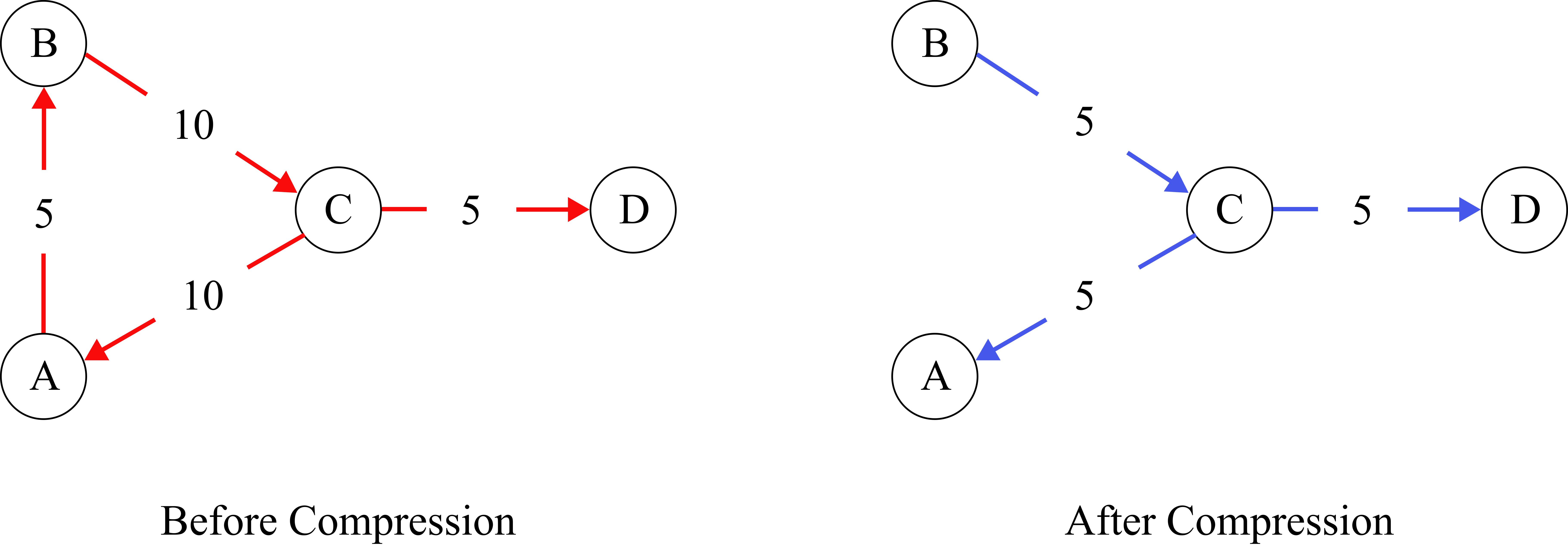
Ideally, compression would eliminate all such cycles of trades from a network. In practice, all cycles may not be eliminated as it requires parties to voluntarily participate and agree to compress trades. The general market practice is that firms take the help of third-party vendors that provide compression as a service and remove only certain trades from their portfolio. While submitting the trades for compression, firms provide their constraints and tolerances.
Portfolio compression can be carried out bilaterally or multilaterally. The best results can be obtained when it is conducted multilaterally. The following example shows both the methods.
Bilateral compression
Let’s suppose the following.
Party A bought 100 shares of Microsoft from Party B @ USD 50 for settlement T+1 year.
Party A sold 50 shares of Microsoft to Party B @ USD 55 for settlement T+1 year.
The market exposure to both the parties is 50 units of Microsoft shares.
The above trades can be compressed into a single trade in any of the following two ways.
Cancel the original two trades and create a new trade at a new price (for example, the new trade is: Party A buys 50 shares of Microsoft from Party B @ USD 45 per share); or
Canel the original two trades and create a new trade at the original price and settle the realized profit now. (For example, the new trade is Party A buys 50 shares of Microsoft from Party B @ USD 50 per share and the realized profit of USD 250 can be settled now by discounting it at the appropriate discounting rate).
In the above example, we achieved a 50% compression in trades (from 2 trades to 1 trade), and a 67% compression in notional value (from 150 notional to 50 notional).
Multilateral compression
Let’s consider the following trades in Microsoft shares by four parties.
Party A sold 100 shares to Party B
Party A bought 50 shares from Party C
Party A bought 75 shares from Party D
Party B bought 50 shares from Party C
Party B sold 75 shares to Party D
Party C bought 50 shares from Party D
Ignoring the price, the volumes can be depicted diagrammatically in the following way.
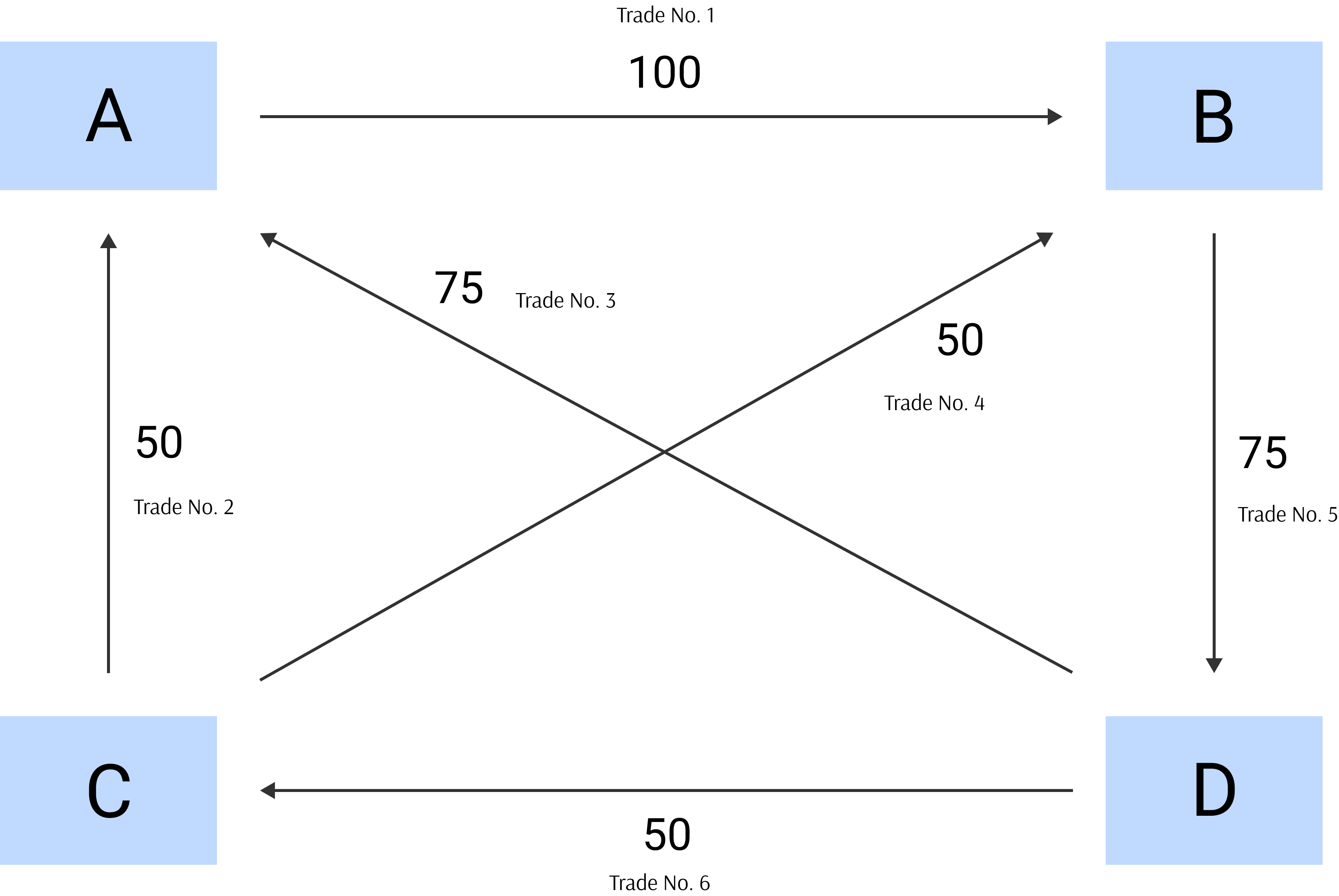
From the above picture, the following information can be obtained.

The gross notional of all the six trades is 400 and the net open interest (sum of all long and short positions) is 100. These trades can be compressed as follows.
A bought 25 shares from C
B bought 25 shares from C
B bought 50 shares from D
The result of the above three trades in terms of net positions is as follows.

As we can see, the net exposure remains the same after compression but the gross exposure and the number of trades have changed. The total gross notional after compression is 100 (a compression of 4 times – from 400 notional to 100 notional) and the number of trades is 3 (a compression of 50% - from 6 trades to 3).
Steps in compression
The following are the general steps in compression, if a third-party service is used.
Step 1) Participants submit trades for matching.
Step 2) Participants agree to parameters and tolerance levels.
Step 3) The third-party service provider runs the compression algorithm, and results are informed to participants.
Step 4) The trades are compressed.
Advantages of portfolio compression
The following are the advantages of portfolio compression.
Reduction in counterparty credit risk.
Reduction in operational risk
Reduction in capital charge under Basel III
Reduction in systemic risk